
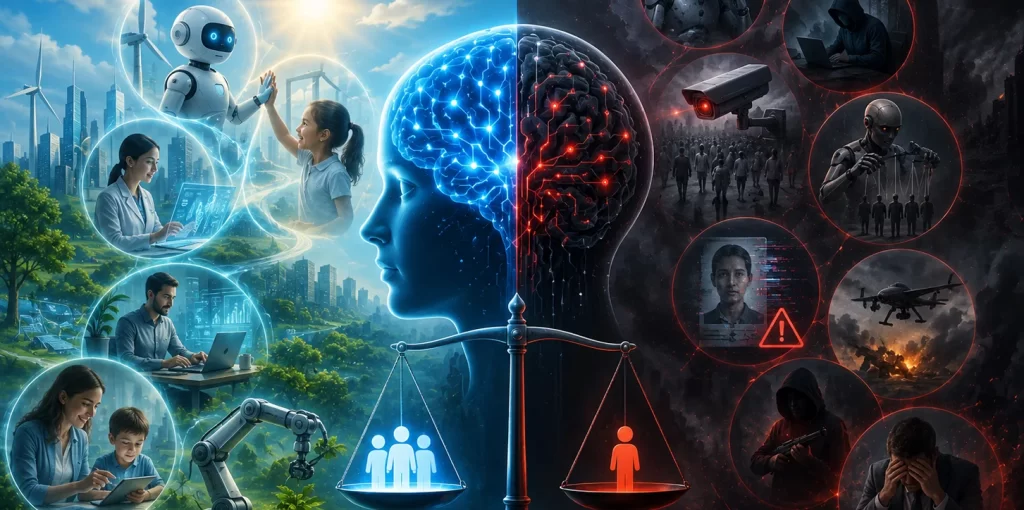
Artificial Intelligence, as the name suggests, is a technological revolution that has made its way through the world. It marks the beginning of a new era in technology and human life. AI is now used in almost all sectors and is not limited to the IT industry. It is making its way into healthcare, medicine, electrical industries, e-commerce and many more sectors.
Artificial Intelligence, popularly known as AI, is one of those segments that has garnered attention around the world. It is one of the core areas in which major technology companies such as Amazon, Google, Apple and Microsoft are investing heavily.
Today, AI is not only used for traditional automation and data analysis. Generative AI can also create text, images, videos, audio, presentations and computer code. These developments are changing how businesses communicate, create content, solve problems and deliver services.
AI technology continues to evolve, the combination of artificial intelligence, human creativity and responsible decision-making can help businesses build better solutions and adapt to a changing digital world.
Artificial Intelligence: The Future Exploring Ahead
Artificial Intelligence holds the future due to the applications it possesses that are useful for living beings on the earth. We can see or forecast flying drones, robotic surgery, driverless cars, human computers, robotic workers and many more applications. These developments provide a broad horizon for this advanced technology.
One cannot even imagine all the possibilities of AI. The kind of innovation taking place in this industry will surely influence many areas in the coming years. AI chatbots, which are among the most common applications used by websites and apps around the world, were an early example of this technology. Since then, AI has flourished by establishing its presence in various industries.
Some remarkable developments have become possible due to Artificial Intelligence, whether it is robotic surgery, drone technology, virtual shopping experiences or other applications. There are ample opportunities in this field that hold the future.
Generative AI and Agents
One of the important part in development is Generative AI. These systems can create new content based on user instructions and learned patterns. Any business can use them to prepare content, explore ideas, summarize the information and support software development.
Next point is AI agents unlike a basic chatbot that primarily responds to questions. AI agent can be designed to complete a series of tasks using tools and instructions. Based on the system, an AI agent can to research information, organize data, assist with software development, customer support service etc.
Technologies can improve productivity, but they should be required to be careful monitoring. AI systems can misunderstand your instructions, provide wrong information or take actions that need human review. Businesses should establish clear permissions and maintain human oversight for important decisions.
Major Pros and Cons of Artificial Intelligence
Artificial Intelligence is known for its prominent advantages that it has provided for human beings, it has various benefits that are useful for mankind include the following:
-
Automation: –
Automation is often considered as the most privileged benefits of AI, it has catalysed the processes in the industry of IT , transportation, E-commerce shopping, industries and communication as well. AI can help businesses handle repetitive activities, reduce manual effort and improve productivity.
-
Refined Experience for Consumers: –
Customer queries can be responded, quickly and efficiently without any dependence on human help. Chat-bots is one of the best ways to define the usage of AI in enhancing customer experience. AI assistants can also understand more complex questions, summarize information and provide personalized responses.
-
Medical Assistance: –
Artificial Intelligence has a varied application for providing medical assistance in the healthcare sector to process the applications smoothly. AI can assist healthcare professionals with medical image analysis, research, administrative tasks and the organization of patient information.
-
Resolving Complex & Difficult Problems:-
The progress in AI technology has helped in the advancement of Machine deep learning algorithms that are capable of resolving complex and difficult problems. AI can analyze large amounts of data, identify patterns and support research in areas such as scientific discovery, engineering, logistics and climate analysis.
-
Enhancement in Business Efficiency: –
AI has the efficiency to provide 24×7 Hour service availability for the customers and ensure performance properly. It helps to improvise the efficiency of the business regularly. AI-powered tools can also help organizations create content, prepare reports and manage certain digital workflows.
Some Disadvantages of Artificial Intelligence :
-
High Risk of Unemployment: –
The rapid pace of development in Artificial Intelligence has created the dilemma of creating the risk of unemployment that pops in the minds of the people. Although, it’s not sure that it might create a risk of unemployment for humans the ways of working will evolve with AI. Although AI may automate certain tasks, it does not necessarily mean that every job will disappear.
-
Expensive Cost of Implementation: –
Machine learning and AI algorithms tend to have high infrastructural and manpower costs as compared to the current technology. Besides that, the maintenance cost is very high for AI products and service providers. The cost of AI implementation depends on the type of technology, the size of the business and the complexity of the project.
-
Data Privacy Security: –
AI tools may process business documents, customer information, personal data, financial records or confidential project details. Sharing sensitive information with an AI system without understanding its data policies can create unnecessary risks.
-
Copyright & Ownership: –
AI-generated content has also raised questions about copyright, ownership and the responsible use of creative material. Before using AI-generated assets commercially, businesses should review the terms of the AI platform.
Conclusion :
AI continues to transform the way businesses operate, communicate and develop new solutions. From automation and customer service to generative AI, creative design and autonomous workflows, the technology offers several opportunities for improving efficiency and productivity. At the same time, AI introduces important challenges related to employment, privacy, security, misinformation, bias and copyright.
